Review
Research Article
Aim & Scope
The “Manas Journal of Engineering” (MJEN) is an international online journal in English published at least 2 issues per year. The aim of MJEN is to publish peer reviewed research articles, short communications and review articles in rapidly developing field of Engineering. This is an online open access journal having full access to the research and review papers. Users are allowed to read and download the articles with free of cost. The journal aims to cover the latest outstanding developments in the field of Chemical Engineering, Computer Engineering, Food Engineering, Applied Mathematics.
MJEN would take much care in making your article published without much delay with your cooperation.
“Manas Journal of Engineering” (MJEN) would provide a platform for budding scientists, researchers, research scholars, academicians and Industrialists etc. to present their research findings in the field of Engineering with least time loss.
This journal was published by Kyrgyz-Turk Manas University, under the name of Manas Journal of Natural Sciences (Manas Fen Bilimleri Dergisi), starting in 2001. In 2013, publication was resumed under the current title, i.e. Manas Journal of Engineering (Manas Mühendislik Dergisi).
Author Guidelines
Manas Journal of Engineering is an international peer-reviewed open access online journal at the field of Engineering Science (applied mathematics, food, ecology, chemical and computer engineering, biological chemistry, environmental analysis, geochemistry, materials science etc.) which aims to contribute to universal knowledge by publishing original works (full papers, short communications, technical notes etc.) at international level with scientific qualifications.
Only English Language is allowed writing the manuscript in MJEN. The following rules should be considered in submitting papers.
Articles must be submitted using the DergiPark submission platform http://dergipark.org.tr/journal/2464/submission/start. Article template can be downloaded here.
It is necessary to conduct a plagiarism scan for the article with the plagiarism programme in the Dergipark article upload section. There should be a maximum similarity rate of 20%, excluding the bibliography.
- Article Title
- Author’s name and affiliation. Please use full first name (not an initial) and properly capitalize all names.
- Paper title.
- An abstract (between 150 to 350 words). It should outline the research object, problem or question; the main findings; the method of analysis used; the significance of what is proposed in relation to existing scholarship in the field.
- Keywords (3-6) The main text part should include
- Introduction
- Literature Review
- Methods and Materials
- Results and Discussion
- Conclusion
- References
Acknowledgments part (if any) should cover the name of supported foundation items and placed before References part.
• Additional Templates (Optional)
TR Index has added the following ethical rules to the criteria of 2020. Please, comply with these rules in studies requiring Ethics Committee Permission.
1. “Ethics Committee Permit” is required for all kinds of research conducted with qualitative or quantitative approaches that require data collection from participants using survey, interview, focus group work, observation, experiment, interview techniques.
2. The articles should state whether an ethical committee permit and/or legal/special permit is required. If it is required, a permit document must be submitted.
3. “Ethics Committee Permission” is required for researches using humans and animals (including materials / data) for experimental or other scientific purposes.
4. If the study requires the use of human or animal subjects;
a. “Ethics Committee Permission” is required,
b. The study should comply with international standards/guidelines, etc. state that it is performed properly.
5. "Ethics Committee permission" is required according to the law for the protection of personal data for retrospective studies.
Article withdrawal process in “dergipark”
The author has the right to withdraw the article while it is in new submission status. If the article is in lower roles or has at least 1 reviewer review, the author can request a withdraw with the approval of the editor. If the editor does not respond to the request within 15 days, the article will be automatically withdrawn.
During the production process, the author will only be able to send requests and the 15-day period will not apply. With this feature, a withdraw card has also been added to the editor panel. Withdraw requests can be viewed from this card.
click here for detailed information
Publication Charges
MJEN is an online-only Open Access journal distributed free of charge.
Articles must be submitted in English only.
All submitted manuscripts will be considered for publication free of charge.
Ethical Principles and Publication Policy
Manas Journal of Engineering- Statement of Publication Ethics
In Manas Journal of Engineeering (MJEN), the ethical principles of organizations are taken as basis:
a) Committee on Publication Ethics (COPE) - The application is in the evaluation process.
b) YÖK Scientific Research and Publication Ethics Directive
c) TÜBİTAK - Research and Publication Ethics Committee Regulation
RESPONSIBILITIES OF THE EDITORS
1. Decision on acceptance is made by the editor-in-chief and field editors upon reviewers' recommendation. Thus, they are responsible for the following decisions:
• sending articles for peer-review per the purpose and publication policies of the journal;
• sending articles for publication per the purpose and publication policies of the journal;
• rejecting article if it is subject to copyright infringement, and plagiarism policies.
The editor-in-chief is responsible for the content and publication quality of the journal and has the right to negotiate with the referees while making the publication decision in this context.
The editor should provide a fair and equitable peer-review and review process. It is the editor's responsibility to respond to the needs of readers and writers of Manas Journal of Engineering.
2. Conflict of interest: The editor-in-chief and field editors of Manas Journal of Engineering are responsible for not disseminating unpublished material and other information and data in the manuscripts submitted to the journal by the author(s) without explicit permission from the author(s).
3. Impartiality: Articles submitted to the Manas Journal of Engineering should always be evaluated per clear, transparent, scientific, and objective criteria without any prejudice. The manuscripts should be evaluated only within the framework of their intellectual and scientific values, without considering the race, color, gender, sexual orientation, religious belief, ethnic origin, nationality, and political view of the authors.
4. Confidentiality: The editor-in-chief, associate editors, field editors, and the editorial board should not disclose the information about the submitted manuscripts to anyone other than the aforementioned manuscript author(s), peer-reviewers, and publisher. Any information about an article submitted to the journal should not be disclosed by the editor to anyone other than the editorial board, referees, and the journal owner. Editor-in-chief is responcible for protecting research data, and author's data. Confidentiality principles should continue after completetion of the editorial process, regardles of the rejection or publication of an article.
5. Editors; The author is obliged to carefully examine the complaints from the peer-reviewers or readers and respond in an enlightening and explanatory manner.
6. The owner, publisher, and any other political or commercial factor do not affect the editors' independent decision-making.
7. Other ethical principles that editors must abide by are:
• Articles that are concidered to be unsuitable for publication in the MJEN can be returned. Other articles are sent to the experts in the field for peer-review.
• An appropriate language that is not offensive or condescending is used when reporting the reasons for rejection (not being related to the subject of the journal, inappropriate writing-content-editing, lack of novelity, etc.).
• Evaluation of articles submitted to MJEN should not delayed intentionally or by negligence. It is unethical to block the article or delay its publication.
• It is important to evaluate whether the study complies with ethical guidelines.
• The article must not be sent to the reviewers who may (could) have a conflict of interest on the subject.
• Editor-in-chief and field editors may or may not follow reviewer suggestions by the author without specifying the name.
• Article information cannot be used in the research by anyone in the editorial team before the work is published; neither should it be made available to others.
• Upon request of authors, editorial office provides information about the status of their submission. Throughout the evaluation process, authors should not be given false information.
• Persons and institutions that provide financial support to the journal are indicated.
• An article rejected by reviewers is returned, nothing should be kept except a copy of the correspondence (reviewers reports are kept for at least 5 years).
RESPONSIBILITIES OF THE REVIEWERS
Peer-Review Statement
All articles submitted to MJEN are subject to peer-review by at least two reviewers who are experts in areas relevant to the journal's topics. Articles are reviewed in full publishable form. Reviewers fill out the review form and provide authors with comments intended to improve the content, style, and other issues that can improve the quality of the article. Reviews are based on the following indicators:
1. Value or usefulness for a field or profession.
2. Design adequacy / accuracy of analysis.
3. Presentation and interpretation of results, discussion and conclusions.
4. Inclusion of relevant implications for practice.
5. Important and timely.
6. Relevance to existing literature.
7. General clarity of ideas and expression.
8. Grammatical construction; Writing style; use non-sexist language.
Ethical Guidelines for Reviewers
Reviews on articles should be objective assessments of the study. If you cannot, or are not sure that you can review an article impartially, you should not accept it for peer-review or notify the editor about it as soon as you assess the situation. If you have any professional or financial ties that may be perceived as a conflict of interest when reviewing an article or a personal disagreements with the author(s) in the past, you should describe them in your confidential comments.
If, as a reviewer, you consider that you are not qualified to evaluate the research component, you should inform the editor in your review.
Reviews must be constructive and polite, and the reviewer must respect the intellectual independence of the author. The reviewer should avoid personal comments.
In the same way that you want a quick assessment of your own research, please return your feedback within the time period indicated by the journal editor when you are asked to review the article. If there are events prevent timely view, you must inform the editor about this at the time of the request.
The submitted manuscript is a privileged communication and should be treated as a confidential document. Please destroy all copies of the manuscript after reviewing. Please do not share the manuscript with colleagues without the explicit permission of the editor. Reviewers should not use data or interpretations for personal or professional purposes before publishing without the express permission of the authors (unless you are writing an editorial or commentary that accompanies the article).
Criteria for peer-review:
Articles should report a major breakthrough in a particular field.
Overall Recommendation: Please give your article review report based on the following categories:
Technical rigor: assess whether the results and interpretations given in the article are consistent with the data and methods used in the study. If necessary, indicate what additional information (methods, text or data) is needed. In some cases, if necessary, it is possible to request additional data. If such cases, your review should also include an assessment of additional materials.
Novelty: indicate in your review whether this study brings novelty to the area of interest.
Length: The volume of articles can be up to 6 printed pages (from 5,000 to 6,000 words).
Security: Do you have any concerns that the article may be dangerous to public health, safety or security, please let the editor-in-chief know about this for further evaluation.
Conflict of interest: if for any reason you cannot review the article impartially, let us know immediately. If you have any financial or professional affiliations that may be perceived as a conflict of interest in reviewing the article, please describe them on our online review form.
Confidentiality: We expect reviewers to protect the confidentiality of the article and ensure that it is not disseminated or exploited. Please destroy your copy of the article when you complete the review. You can discuss the article only with the editor. We do not disclose the identity of our reviewers.
Return your review: Please return your review using our form at https://dergipark.org.tr/tr/pub/mjen
AUTHOR GUİDELİNES
Manas Journal of Engineering is an international peer-reviewed open access online journal at the field of Engineering Science (applied mathematics, food, ecology, chemical and computer engineering, biological chemistry, environmental analysis, geochemistry, materials science etc.) which aims to contribute to universal knowledge by publishing original works (full papers, short communications, technical notes etc.) at international level with scientific qualifications.
Only English Language is allowed writing the manuscript in MJEN. The following rules should be considered in submitting papers.
Articles must include:
Article Title
Author’s name and affiliation. Please use full first name (not an initial) and properly capitalize all names.
Paper title.
An abstract (between 150 to 350 words). It should outline the research object, problem or question; the main findings; the method of analysis used; the significance of what is proposed in relation to existing scholarship in the field.
Keywords (3-6) The main text part should include
Introduction
Literature Review
Methods and Materials
Results and Discussion
Conclusion
References
Acknowledgments part (if any) should cover the name of supported foundation items and placed before References part.
TR Index has added the following ethical rules to the criteria of 2020. Please, comply with these rules in studies requiring Ethics Committee Permission.
1. “Ethics Committee Permit” is required for all kinds of research conducted with qualitative or quantitative approaches that require data collection from participants using survey, interview, focus group work, observation, experiment, interview techniques.
2. The articles should state whether an ethical committee permit and/or legal/special permit is required. If it is required, a permit document must be submitted.
3. “Ethics Committee Permission” is required for researches using humans and animals (including materials / data) for experimental or other scientific purposes.
4. If the study requires the use of human or animal subjects;
a. “Ethics Committee Permission” is required,
b. The study should comply with international standards/guidelines, etc. state that it is performed properly.
5. "Ethics Committee permission" is required according to the law for the protection of personal data for retrospective studies.
To get information about the ethics committee requirement: please click on the link please
Publication Charges
MJEN is an online-only Open Access journal distributed free of charge.
Articles must be submitted in English only.
All submitted manuscripts will be considered for publication free of charge.
Price Policy
There are no article processing and publishing charge associated with Manas Journal of Engineering
Indexes
Citation Indexes

Other Indexes





Journal Boards
Scientific Publication Coordinator

Editor in chief


Associate Editor


Field Editors



Editorial Board

Editorial Advisory Board






 Web
Web
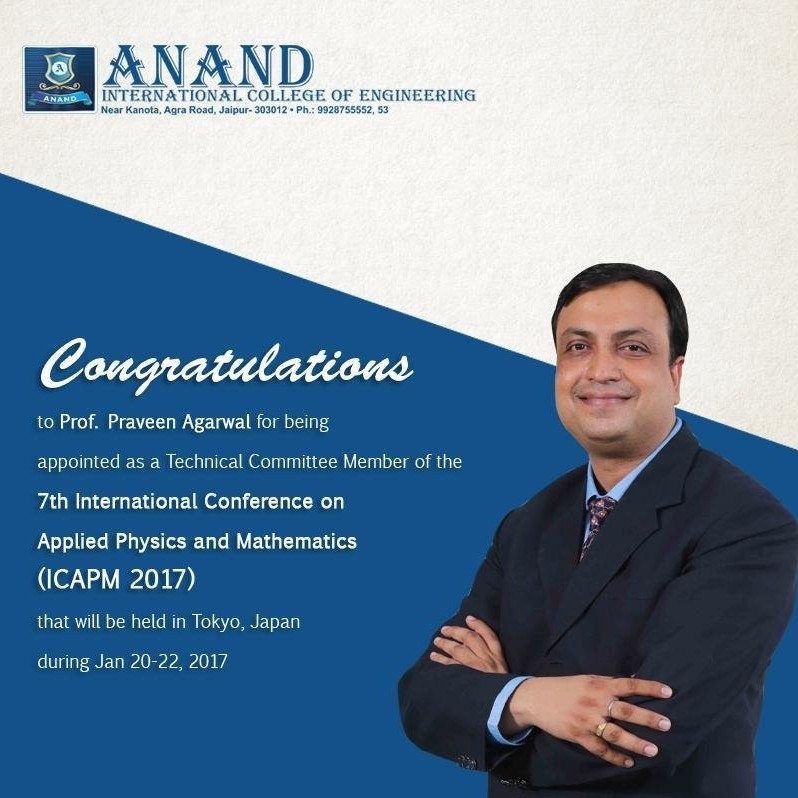
Dr. P. Agarwal is a Vice Principal, Professor, and Researcher at Anand International College of Engineering (Anand-ICE), where he oversees the academic administration, international collaboration, ranking and accreditation, and research and development activities. He is also a Managing Editor at Springer Nature Group and a Book Series Editor at CRC Press, where he curates and publishes high-quality books on mathematics for sustainable development. With over 22 years of experience in teaching and research, he is one of the world's top 2% scientists according to Stanford University and Research.com, and a recipient of multiple awards and honors, including India’s Top 10 Mathematicians by Careers 360.
Dr. Agarwal's research interests span across special functions, fractional calculus, numerical analysis, differential and difference equations, inequalities, and fixed point theorems. He has authored or co-authored over 325 high-impact journal papers, 12 books, and one patent. He has also delivered over 300 invited talks and keynote lectures at prestigious institutions and conferences around the world. He has served as an editor or associate editor for more than 50 journals, and organized several international conferences, workshops, seminars, and summer schools. He is passionate about advancing the frontiers of mathematical knowledge and innovation, and inspiring the next generation of mathematicians and engineers.

Mehmet Odabaşı lisans eğitimini Atatürk Üniversitesi Kimya Bölümü’nden, yüksek lisans ve doktora derecesini biyokimya alanındaki çalışmaları ile Hacettepe Üniversitesi'nden aldı. Aksaray Üniversitesi’nde, 2007 yılında Yardımcı Doçent, 2012 yılında Doçent ve 2018 yılında Profesör oldu. Dr. Odabaşı, Aksaray Üniversitesine başladığı 2007 yılında, Biyokimya ve Biyokromatografi Araştırma Grubu'nu kurdu (biochemreg.com). Dr. Odabaşı’nın çalışma alanları, polimerik membranlar, monolitik kolonlar, kriyojeller, kopozit malzemeler, mikroküre ve magnetik taşıyıcıların hazırlanması ve protein enzim, antibadi, nükleik asit ve hormonlar gibi biyolojik moleküller ile ağır metal ve mikrosistin gibi çevresel atıkların uzaklaştırılması üzerinedir.
Layout
Publishing Editor
Tehnical Editors


Manas Journal of Engineering